Trosyn AI
Digital Product · Founder · Product design · UX/UI
Turning complex private-AI infrastructure into a clear business product.
Private AI infrastructure for businesses that need control. Trosyn AI was shaped around company-controlled environments, sensitive document workflows and a product story that both technical and non-technical stakeholders can follow.
01 / Overview
A private-AI product with a human-facing story.
Trosyn AI is private AI infrastructure designed to run inside company-controlled environments so sensitive document workflows can stay local. As founder, Ivan shaped the product direction and public-facing experience, translating infrastructure decisions into language, structure and flows that business decision-makers can understand.
- Project
- Trosyn AI
- Type
- Digital Product
- Role
- Founder · Product strategy · Product design · UX/UI · Website
- Focus
- Private AI · Workflow design · Product positioning
- Location
- Kampala, Uganda
- Website
- trosyn-ai.vercel.app ↗
02 / The problem
Private AI is easy to describe in infrastructure terms. It is harder to make useful in business terms.
The source case study frames a product for organisations working with sensitive documents, uneven connectivity and stricter control requirements. A cloud-first AI story can leave unanswered questions about where processing happens, who governs access and what teams can rely on when the network is not the whole answer.
Connectivity
The public product story addresses operating contexts where constant cloud access cannot be assumed.
Infrastructure
Deployment needs to be understandable without asking a buyer to begin with a systems diagram.
Data control
Sensitive work needs a clear organisational boundary for processing, access and governance.
These are product-context and positioning statements from the Trosyn source material and public website. They are not an independent security audit or a quantified performance claim.
03 / Design challenge
Making private AI understandable beyond the technical team.
The design work was a translation problem: preserve technical credibility while giving a non-technical decision-maker a clear reason to care.
Explain where the system runs and what that changes for the organisation.
Frame control as an operating choice, without making absolute security promises.
Turn device, team and enterprise paths into a progression people can compare.
Connect the underlying system to recognisable document-heavy work.
04 / Information architecture
The public story follows the questions a buyer has to answer.
Rather than opening with internal software architecture, the experience moves from the business problem to the product’s promise, boundaries, choices and next step.
- 01
Problem
Why cloud-first assumptions can fail where reliability and control matter.
- 02
Value
What private AI makes possible for sensitive internal work.
- 03
Control
How local processing and company rules shape the operating boundary.
- 04
Deployment
Which mode fits a device, a team or a future enterprise path.
- 05
Workflows
Where document-heavy teams can evaluate the product’s relevance.
05 / Privacy and control
Make the boundary clear before explaining the machinery.
The product narrative leads with control, local processing and governance because those are the questions that determine whether private AI is relevant to a business. That makes the concept concrete without claiming that a page of copy can prove every operational or security property.
The public website presents Trosyn as running inside company-controlled environments, with sensitive documents and workflow context kept local.
Control is treated as a product benefit and a decision criterion, not as a decorative badge or an unqualified guarantee.
Deployment, security and governance claims require technical and legal confirmation before publication as proof.
06 / Deployment choices
Turn infrastructure choices into an understandable progression.
The source presents one system adapted to different organisational scales. Enterprise is kept visibly separate because the current public product identifies it as a roadmap path.
Device
Presented as a self-serve path for individuals and small teams: a private AI experience on a laptop or desktop without a shared server.
Team
Presented as a shared internal system for multiple people, departments, permissions and repeatable workflows.
Enterprise
Presented as the future path for software installed and maintained on internal servers by the Trosyn team. It is not described here as a released deployment.
Deployment status is based on the current public Trosyn website. Public descriptions are not being presented as independently verified infrastructure documentation.
07 / Workflows
Make the technology legible through recognisable work.
Workflow areas give the product story somewhere to land. Instead of asking people to imagine “AI for the enterprise,” the source connects the private AI layer to the kinds of document-heavy work departments already understand.
Employment contracts, onboarding documents and policy queries.
Invoice generation, financial reports and expense summaries.
NDA drafting, regulatory summaries and compliance checks.
Incident summaries, policy checks, access reviews and internal reports.
These workflow examples are presented in the public Trosyn product story. They do not establish that every workflow pack is fully released or adopted by a customer.
08 / Visual system and website experience
Trust is built through hierarchy, specificity and restraint.
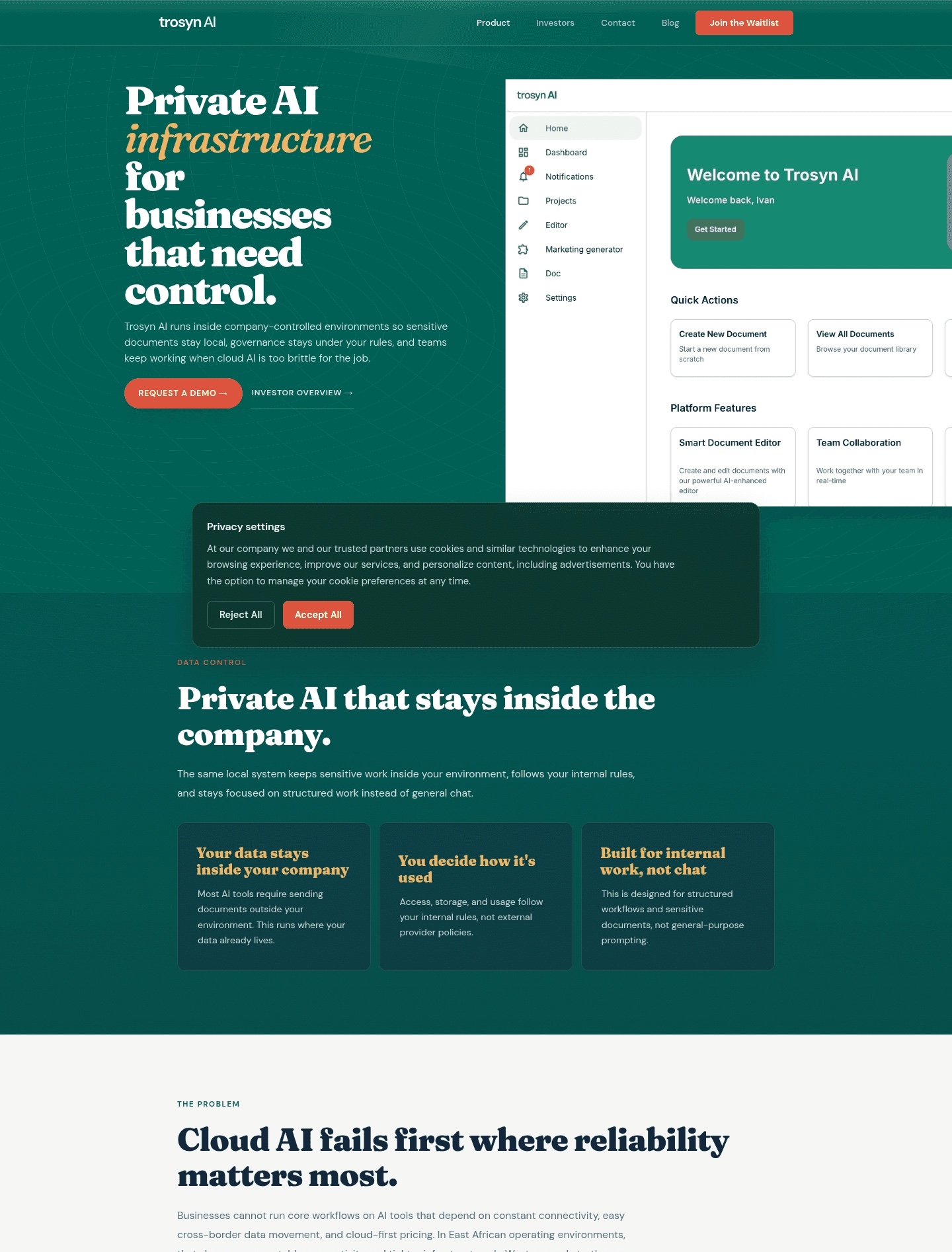
The public website uses a confident editorial hierarchy: a single promise, supporting proof, deployment choices and direct evaluation paths. The visual system keeps the technology approachable without hiding the seriousness of the category.
Lead with the promise
The first screen names the business value before asking visitors to understand local runtimes.
Show a product, not a diagram
The authentic interface image gives the infrastructure story a tangible customer-facing surface.
Progressive disclosure
More detail appears through control, deployment and workflow sections instead of one dense technical explanation.
09 / Responsive experience
The product story has to remain clear when the screen gets smaller.
The responsive treatment keeps the headline readable, lets the product image scale without distortion and moves the story map, deployment modes and workflow examples into a single-column reading sequence.
Keep the value proposition and primary live-site action visible without requiring a complex interaction.
Use the full authentic interface image as a contained visual so the screen remains legible at narrower widths.
Let product context precede detail, with status notes close to the claims they qualify.
A dedicated local mobile screenshot was not part of the approved source set. This section records responsive implementation decisions without inventing mobile-only product behaviour.
10 / Design decisions
The work was making a technical category easier to evaluate.
- 01
Lead with control, not model capability
The story begins with where sensitive work happens and who governs it, because that is the product wedge described in the source.
- 02
Make deployment a choice
Device and Team become understandable operating modes; Enterprise remains a clearly marked roadmap path.
- 03
Connect the system to departments
HR, Finance, Legal and Security examples translate an abstract AI layer into recognisable organisational tasks.
- 04
Use progressive disclosure
Visitors can first understand the promise, then inspect control, deployment, workflow and evaluation detail in sequence.
- 05
Keep claims bounded
Public positioning is separated from independent proof so the page builds credibility without overclaiming security, adoption or outcomes.
11 / Takeaway
The central UX problem was translation.
Trosyn AI required a story that could hold infrastructure, privacy, deployment constraints and real organisational work in the same frame. The design direction keeps the technical boundary visible while giving non-technical stakeholders a clear way to understand the product and decide what to explore next.
Let’s work together
Have a complex product to make clearer?
Let's turn complex ideas into clear digital experiences.
[email protected]